It's probably not something you've given much thought to. Let's be honest, until recently you probably didn't even know what spuddling was.
But now that you do, there's an uncomfortable question you need to ask yourself.
Are you a spuddler? Or are you an innocent victim of someone else's spuddling?
And here's the really worrying possibility. Could you be both?
How do you recognise a spuddler?
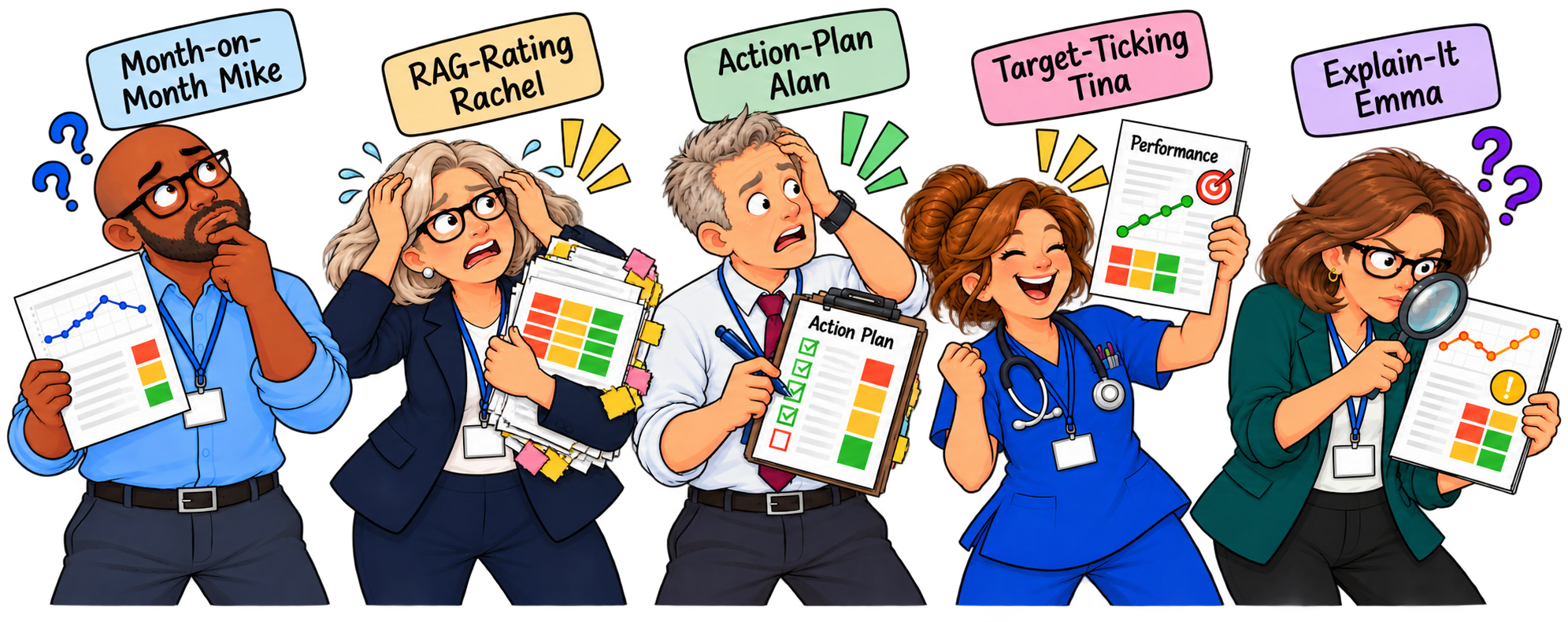
Spuddling takes many forms. Some are obvious. Others are so deeply embedded in everyday working life that we've stopped noticing them.
Here are five warning signs.
1. The month-on-month obsessive
Performance went up last month. Brilliant! Performance went down this month. Disaster!
Never mind that both figures are entirely consistent with the way the process has been performing for the last two years.
The spuddler demands an explanation for every movement, however trivial.
2. The RAG enthusiast
Their performance report is a glorious sea of red, amber and green.
Green means everything is fine. Red means someone needs to do something. Amber means... well, nobody is entirely sure.
The colours may look impressive, but do they actually tell us whether performance is changing?
3. The action-plan addict
Every red indicator needs an action plan. Every deterioration needs an investigation. Every meeting generates another list of things to do.
Whether any of those actions will make a difference is another matter entirely.
But at least we're doing something!
4. The target celebrator
Performance has just crept over the target. Celebrations all round!
Next month it slips below the target. Cue the emergency meeting.
Nothing fundamental has changed, but that doesn't stop the celebrations or the panic.
5. The explanation hunter
"Why did performance fall by 0.3% last month?"
It's a familiar question, often directed at an analyst or operational manager who is expected to produce a convincing explanation.
Cue hours of investigation and increasingly creative attempts to explain something that might simply be routine variation.
But what about the victims?
Spuddling isn't just something people do. It's something that happens to people.
Think of the clinician who is required to spend hours investigating meaningless fluctuations when they want to focus on delivering genuine improvement.
Or the operational manager who has to write yet another action plan because an indicator has turned red, despite no evidence that anything has actually changed.
Or the board member who sits through pages of performance commentary without gaining any real understanding of whether services are improving, deteriorating or staying the same.
All that time. All that effort. All that spuddling.
And perhaps the greatest cost of all? While we're busy reacting to things that don't matter, we risk missing the changes that really do.
The uncomfortable truth
Here's the thing. Most spuddlers aren't deliberately wasting anyone's time.
They're doing what they've always done. Asking the questions they've always asked. Using the reports they've always been given.
And that's what makes spuddling so difficult to eradicate.
It has become normal.
The good news? Once you learn to recognise it, you can start doing something about it.
The Spuddling Challenge
At your next performance meeting, see how many times someone:
· Demands an explanation for a tiny movement in a number.
· Calls for action simply because performance this month was worse than last month.
· Celebrates success because a target has been met, without checking whether performance has genuinely improved.
· Obsesses over changes in the numbers rather than whether the actions being taken are actually making a difference.
How many did you spot?
And here's the uncomfortable question...
How many were you responsible for?
Or, perhaps more importantly...
Are you causing someone else to spuddle?
So, are you a spuddler?
Perhaps you've recognised a few familiar behaviours. Perhaps you've thought of a colleague who really ought to read this.
Or perhaps you're feeling just a little uncomfortable.
There's only one way to find out.
Take the Spuddling Self-Assessment!
And remember, recognising spuddling is the first step towards stopping it.