What on earth is Spuddling?
It was in the very early days of Making Data Count that the existence of the word spuddling came to light.
My colleague Leigh bounced into the office one morning and announced that he had exciting news. He had a grin on his face as he explained that he’d been watching Countdown the evening before and had learnt a new word.
Yes – you’ve guessed it. The word was spuddling.
It was a new word to us, but one that had been commonplace in years gone by.
I’m guessing that most of you haven’t encountered the word spuddling. You might think it’s something to do with potatoes… or perhaps it’s a new management term. I certainly had no idea.
But as soon as Leigh explained what it meant, I knew we were onto a winning word.
Spuddle (verb)
“To make a lot of fuss about trivial things, as if they were important.”
First recorded in the 17th century and still found in regional dialects several centuries later, spuddle had become largely obsolete by the 20th century. This particular definition can be found in Joseph Wright’s English Dialect Dictionary, published between 1898 and 1905.
And once we’d heard the definition, we realised that it perfectly described behaviour we encountered every day.

Every week, countless hours are wasted in the NHS making a lot of fuss about things that, in reality, may not be important at all.
I wonder if you can guess one of the main culprits from my perspective?
If you guessed RAG performance reports, you’d be correct.
Performance is worse this month than last month. Questions are asked. Explanations are demanded. And if the target has been missed and performance has turned red, action plans are quickly put in motion.
Next month, performance improves. We’re green again. Everyone breathes a sigh of relief. Perhaps there are even a few pats on the back.
What if those movements in the data were simply expected variation? The same process and the same behaviours could result in red performance one month and green the next.
That’s spuddling.
And people at all levels of an organisation are at risk of becoming spuddlers. It doesn’t matter whether you’re a nurse, healthcare assistant, project manager, doctor or Executive Director.
Nobody is exempt.
So, what’s the solution?
The good news is that there is a very effective approach called statistical process control (SPC), which helps us understand the variation in our data and distinguish between changes that are worth investigating and those that aren't.
Back in the summer of 2019, I was discussing spuddling with the board at Kettering General Hospital NHS Foundation Trust when they had a brilliant idea.
They asked if we could create spuddling cards to help keep them on the straight and narrow.
A yellow spuddling card would be raised if there was a suspicion of spuddling – data related or otherwise. The red card was, of course, a much more serious matter: it indicated a repeating pattern of behaviour.
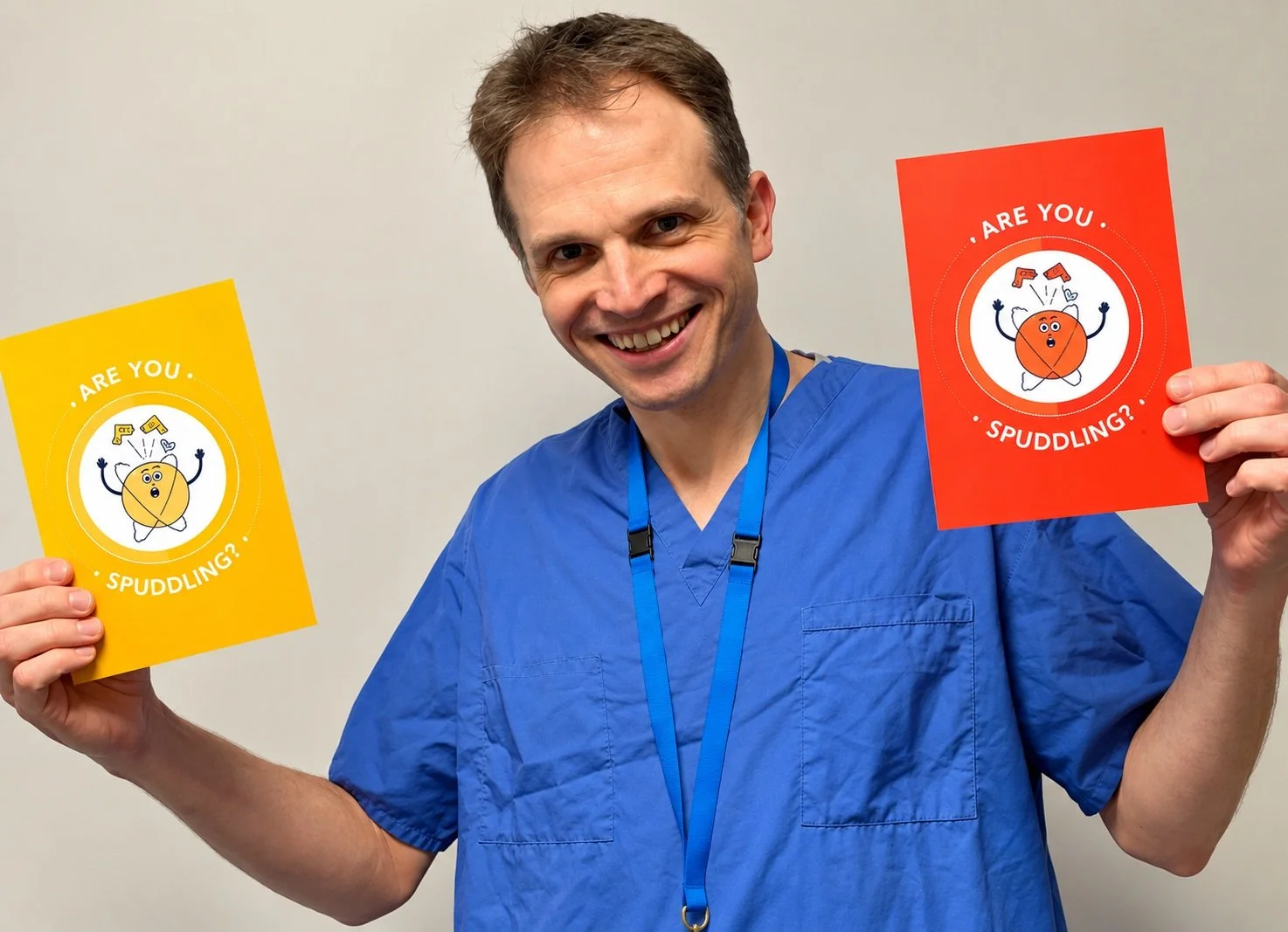
The cards were duly produced and have since been used across many NHS organisations, from board to ward. They provide a simple – and deliberately fun – way of challenging ourselves when we start making a lot of fuss about something that may not actually matter.
And that matters, because every hour spent spuddling is an hour that could have been spent focusing on something that might genuinely make a difference to patients.
So, thanks to Leigh – and Susie Dent – a largely forgotten word has found a new lease of life in the NHS.
Over the years, people have told me that Making Data Count helped them to spend less time spuddling.
There is much more to do though.
Hence the birth of Spuddling Solutions.